
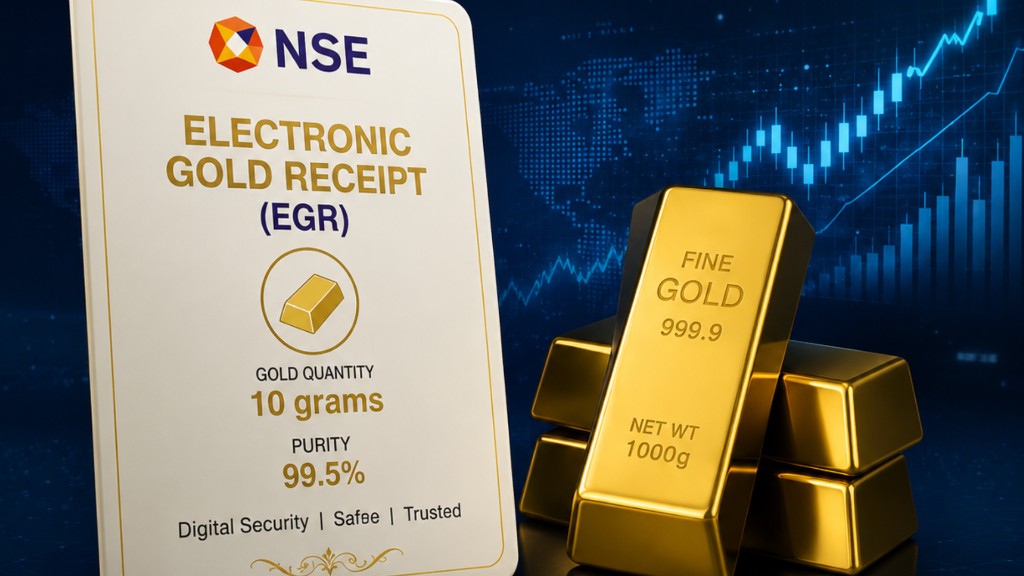
EGRs are exchange-traded securities linked to standardised physical gold of specific purity and mass. Each EGR is backed by 100 per cent physical gold.
Recently, a new gold product—the Electronic Gold Receipt (EGR)—has been generating interest as a way to trade gold digitally, while also offering investors the ability to convert physical gold into a tradable electronic form. However, the process is really not as straightforward as depositing gold and immediately beginning to trade it on an exchange.
Understanding EGRs
EGRs are exchange-traded securities linked to standardised physical gold of specific purity and mass. Each EGR is backed by 100 per cent physical gold. Under the EGR framework, physical gold is stored with a Vault Manager (VM), which issues EGRs against the deposited gold after it has undergone the required purity testing. These EGRs are listed and traded on stock exchanges. Investors can buy and sell them through a trading and demat account, similar to trading stocks or ETFs. EGRs can be converted into physical gold. The quantity of gold received on redemption corresponds to the unit represented by the EGR.
Converting jewellery into EGR
While some are hailing EGR as an alternative to bank lockers, given the lower costs and no tax on conversion, it is not so easy. The gold that can be deposited needs to meet certain standards - the gold is refined by domestic refineries, which are registered with BIS and accredited with stock exchanges. The gold coming from these refineries should confirm to India Good Delivery Standard for creation of EGR. The purity levels are 999 and 995 - 999 implies 99.9% purity and 995 implies 99.5% purity.
Most gold jewellery in India is made of 22K (91.6% purity) or 18K (75% purity) gold. Since EGRs can only be issued against gold meeting the prescribed purity standards of 995 (99.5%) or 999 (99.9%), jewellery must first be melted and refined into gold bars of the requisite purity before it can be deposited and converted into EGRs.
Moreover, converting EGRs back into physical gold (only in form of bars) is a cumbersome process, involving redemption requests, coordination with the vault manager and collection of the physical gold.
Investors need to decide whether they are willing to melt their jewellery, incur refining and conversion costs and not receive the same ornaments back in their original form.
Costs
EGR costs include vault storage charges, depository and brokerage charges, 3% GST and withdrawal costs in case of physical gold. Unlike Gold ETFs which have an expense ratio of 0.6%, EGRs do not have a single bundled cost.
Furthur, being a new product, the liquidity in EGRs is currently limited. In such cases, EGRs may trade above the underlying gold price when purchased and below it when sold, thus eroding returns.
Ultimately, the practical appeal of EGRs will depend on factors such as transaction costs, liquidity, bid-ask spreads and the ease with which investors can buy, sell, and redeem them. While the product introduces an innovative link between physical and digital gold ownership, its advantages over existing gold investment avenues remain limited at present. For investors already using gold ETFs or gold mutual funds, EGRs do not currently offer a compelling reason to switch, especially given the established track record, liquidity, and convenience of these alternatives.
The author is a Financial Educator & Founder Director of Finsafe India Pvt Ltd
Published 01 June 2026, 01:59 IST